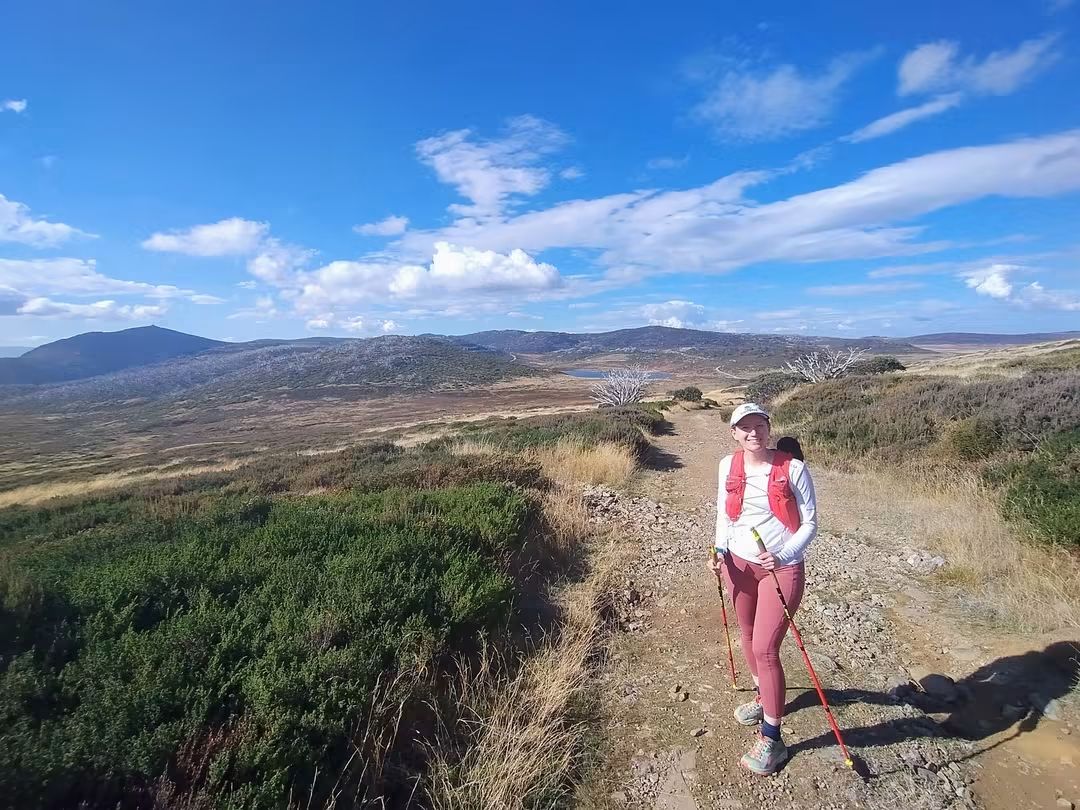
160 km. Around 7,000 metres of climbing. Almost entirely self-supported through Victoria’s high country. The Alpine Challenge 100 Mile had been sitting in the back of my mind since my second GPT 100 Mile attempt was cancelled mid-race. This time, I wanted a great mountain day and night out — and that’s exactly what I got.
Race details
- Location: Falls Creek, Victoria
- Date: Saturday 12 April 2025
- Distance: 100 miles / 160 km
- Elevation: around 7,000 m ascent and descent
- Time: 27:48:07
- Result: Equal 3rd
The course
Falls Creek – Spion Kopje – Mt Bogong – Mt Hotham – Mt Feathertop – Mt McKay – Falls Creek. Five major creek crossings where you have to refill water.
This is one of Australia’s most demanding and scenic ultras. Runners need to be prepared for extreme alpine conditions, night running, navigation and long stretches of self-sufficiency. There are basically no course markings until the final 5 km. You’re relying on your wits, your watch and your willpower.
I had three drop bags — one of which we passed twice — and no crew. From the 100 km mark onwards there were no drop bags and only one aid station.
The build-up
After my second attempt at the GPT 100 Mile was cancelled mid-race due to excessive heat, I was itching for another crack at the distance. Annie and I had done the 60 km version of Alpine Challenge in 2022 and scored perfect weather, but this race is known for being wildly unpredictable.
Luckily, this year delivered shirt weather all day — even at night on top of Mt Feathertop. That’s rare.
Training in the lead-up was average. Two months out I managed a solid 10-hour run from Bellingen to Point Lookout, an FKT, and squeezed in a flat 5 km PB. But I never ran more than 10 hours in a week. That’s the thing about 100 milers, especially this one. It’s not just about fitness. It’s about staying injury-free, managing logistics and being mentally ready for a long day and night in the mountains.
My goal? Just to have a great mountain day and night out.
The start
The plan was to run with Annie for the first 88 km. We followed the same course until the split. We started at 4:30 am, descending singletrack and trails to Rocky Valley Creek. From there it’s a solid 1,000 m climb over 7 km — about 13.2% — up to Spion Kopje.
Up to that point I was taking it easy with Annie. Once the sun came up she was feeling good, confident with navigation and there were others around. She gave me the green light to push on.
The section on top of Spion Kopje is sensational: buttery trails, sweeping views and that dreamy kind of alpine running. There was a little smoke in the air, but visibility was still excellent.
Big climbs and big views
I came into the first checkpoint at 24 km in about 14th place, roughly 20 minutes behind the runner I’d eventually finish third with. I took my time at the aid station, but from this point on I wasn’t overtaken again.
My fuelling plan was double-strength Trail Brew Neutral and Vegemite sandwiches early, then Precision Fuel 90 g gels later. One new thing I tried — and will definitely repeat — was a can of coconut water at each drop bag.
Annie and I left the 24 km checkpoint together, but I went ahead on the descent to Big River. I was using a COROS arm band for heart rate and kept things chilled early, averaging 128 bpm for the first five hours. At Big River I decided to push a little more on the climb up Mt Bogong, aiming for around 145 bpm.
The climb starts steep through forest — around 4 km at 16% — before opening into spectacular high country after Cleve Cole Hut. Hiking is a strength of mine and I gained about seven places on the climb.
It was my first time on Mt Bogong and the views were amazing. The descent off Quartz Ridge was one of the best I’ve ever experienced. The descent back to Big River was rough, though, and I struggled to get my heart rate above 120 bpm on the downs.
Timms Spur: highs and lows
I caught more runners climbing Timms Spur, pushing around 140 bpm and taking a caffeine gel. I don’t drink coffee, so caffeine hits me hard. I got a big boost for about 10 km, then hit a low patch around 70–80 km. Another gel at 80 km gave me a second wind, followed by another dip. When I say “low”, I was still running smoothly — I just had to work for it rather than hold myself back.
I caught third place on the climb and we ran together to Warby Corner Aid Station at 61 km. We left together and hit a more runnable 22 km stretch towards Pole 333. He dropped me along the flat aqueducts, but I could always see him in the distance.
At Pole 333, 88 km in, it was headlamps on and time to commit to the full 100 miles. I called Annabelle to check in. She was doing great on the 100 km course, and I was excited to tackle the night.
Into the night
We descended to the West Kiewa River and I took it easy to protect my knees. I pushed harder on Swindlers Spur — 2 km at about 20% — and came into the 100 km aid station ready to chase some runners down.
After a confusing bush-bash up Mt Hotham and a section of the Razorback, I caught third-place Danny again on the descent of Bon Accord Spur. He wasn’t feeling great and, with a long night ahead, I decided to stick with him. It proved a smart move. We pushed each other through the runnable sections and climbs all the way to the finish.
At Harrietville Aid Station we found a table with water, 100 ml of Coke and a small packet of salt-and-vinegar chips. That was all I took from aid stations for the whole race. I was still enjoying the Precision 90 g gels, taking one about every 90 minutes with a caffeine gel every two to four hours.
The final push
The penultimate challenge was an 8.5 km climb at 14% towards Mt Feathertop, followed by the brutal Diamantina Spur descent.
I led the climb, but my heart rate wouldn’t go above 125 bpm. Heart-rate suppression had kicked in. We eventually reached the summit after a long grind, still in shirt weather — incredible for that altitude and time of night. The descent dragged on, but having company helped. We alternated between chatting, navigating and quiet stretches with music. I didn’t get sleepy; I was just tired.
We reached the bottom of the West Kiewa River and began the final climb to Pole 333. At 133 km I was working steadily up Weston Spur, around 3.7 km at 15%. Danny suggested we finish together as long as we beat his PB. We did, by one hour and 15 minutes.
We arrived at Pole 333 to one of the best sunrises I’ve ever seen across the high plains. I didn’t take photos. I just soaked it in.
After Pretty Valley Pondage we started thinking about finishing time. Sub-28 hours became the goal. Danny had more in the tank but stayed with me. I was able to run at around 6:00 min/km, which feels like flying after 150 km.
After Mt McKay we hit the final technical singletrack and descended the rough ski slope to a relatively underwhelming finish — but I was stoked. Legs were good. Spirits were high.
Final thoughts
With no crew, no pacers and just loaded drop bags, I spent 28 minutes total at five aid stations. A little longer than usual, but in a race with minimal support through the high country it was worth it.
This event isn’t for beginners. But if what you care about is an epic course, solitude and a low-key event vibe, you’ll love it.
Huge congratulations to Annabelle, who smashed the 100 km course and finished third female, navigating it solo.
Recovery
After the race I took two weeks off running — apart from a cheeky 5 km race at Falls Creek. My legs felt okay after a few days, but I had some unusual knee pain that lingered for a full week. Normally I’m good to run again after one week, but this time I could tell my body needed more.
There’s always a risk in doing too much too soon. For me, two weeks seems to be the sweet spot after a big effort like this.
Gear that worked
- Shorts: T8 Sherpa Shorts
- Pack: Salomon Advanced Skin 12L
- Nutrition: Precision Fuel 90 g gels
- Shoes: wide-toe-box trail shoes with Injinji toe socks — no blisters after 160 km
- Headtorch: Fenix HM65R-T
- Watch: Garmin Forerunner 255 — one charge from a battery pack was enough
- Shirt: CTR technical shirt
- Heart-rate monitor: COROS arm band
- Flasks: Hydrapak soft flasks
Thanks for reading. I hope this gives you a sense of what the Alpine Challenge 100 Mile is really like — and maybe inspires an adventure of your own.